-
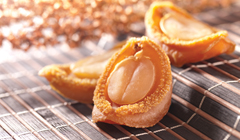 Ami Abalone→ The origin of Ami Abalone is Aomori Prefecture, Japan. The body size of abalone is comparatively bigger. The edge is thick and rough.The suction cap at the bottom part is comparatively sharp. The back of the abalone is in bead shape. It is in dark brown color and there is some white powder on the surface.The meat is in chewy texture and have a strong good smell.
- Kippin Abalone→ Abalones are produced in Iwate Prefecture, Japan, and they are also called Kippin Abalones. They are in gold-ingot shaped, and their occipital edges are high and their bodies upright. There are visible stripes in their bellies, and their bodies are hunched up. Kippin Abalones which are rehydrated by means of soaking and boiling have a strong taste and chewy. They have a beautiful crystal color and their meat is flexible and smooth.
- Ouma Abalone→ The origin of Ouma Abalone is Aomori Prefecture, Japan. Another name is "Uma Abalone". The body shape is flat and having a wide surface. The color is in golden yellow. They are usually dried by using a rope string. That's why the abalone body, around the side, is more smooth and easy to chew and digest. The taste is more smooth, tender and good smell.
Characteristics: Tastes sweet and salty and in mild nature.
Procedures: (1) Soak the abalones in water for about 2 days (depending on their size) until they become soft, and change the water at least once every day.
(2) Thoroughly brush the dust off the abalone body and from the gaps on its edge with a toothbrush, cut off the "stalk" in its mouth, remove its bowels, flush it clean with water, and then set aside for later use.
(3) Place it into hot water with ginger, spring onion, and wine and boil for about 5 minutes. If not cook immediately, it should be chilled (at -4°C to -18°C) for storage and should be cooked and consumed within 1 week.
(4) Place the rehydrated abalone and seasoning ingredients (consisting of 1 old chicken, 605g pork ribs, 5 scallops, and some rock sugar) into a clay pot with a bamboo mat at the bottom, and then add boiling water to cover the ingredients.
(5) Boil over high heat for about 2 hours, turn the heat down to a simmer for 5 to 6 hours, and let it cool down a bit. Then turn the heat up to a boil for another 2 hours, and cook it until the abalone becomes soft, thick, smooth, and tender.
(6) When the soup becomes thick, add boiling water accordingly (so that the water just cover the ingredients. Avoid adding too much boiling water, to prevent the soup from becoming too watery). Then remove the abalone, and add broth and oyster sauce to thicken the soup.
Note: The simmering time can be extended or cut down according to the size, thickness, and the hardness you prefer. Moreover, the abalone gravy must be thickened before serving, because this is the source of its flavor.
Making of the abalone gravy can be done by adding oyster sauce and the original gravy, or oyster sauce and broth, or Jinhua ham gravy and the original gravy.
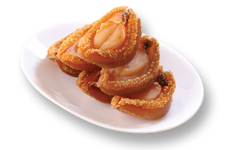 The meat of abalones is tough and has a dense texture. Therefore, the only way to soften it to be perfectly chewable is to cook the abalone meat at the proper cooking temperatures.
- The "soft yolk" of abalone refers to its viscosity and coagulation. The better the quality of an abalone, the stronger its flavor, and the chewier its meat. When slicing the abalone, the knife should cut along the abalone's fiber, so that its texture will be even tenderer. The abalone should be eaten from its outer surface toward the center. Doing so will provide long-lasting aftertaste.
The cooking technique requirement is very high for abalone and it is very time consuming. Customer may take our service of abalone cooking for our customers, which can ask us to cook abalone for customers. Customers may inquire our shop assistant for further information.
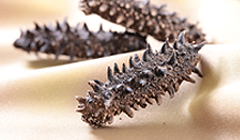 Japanese sea cucumbers are made by drying fresh sea cucumbers. They are a kind of sea food that is of high nutritious value. Though they live in the sea, the sea cucumber is one of a warm-tonifying nature. Similar to ginseng in this regard, they are called Haishen (literally "ginseng of the sea") in Chinese. However, they are not of hot nature. Instead, they are a mild nature food.
.jpg)