(1) House Nest
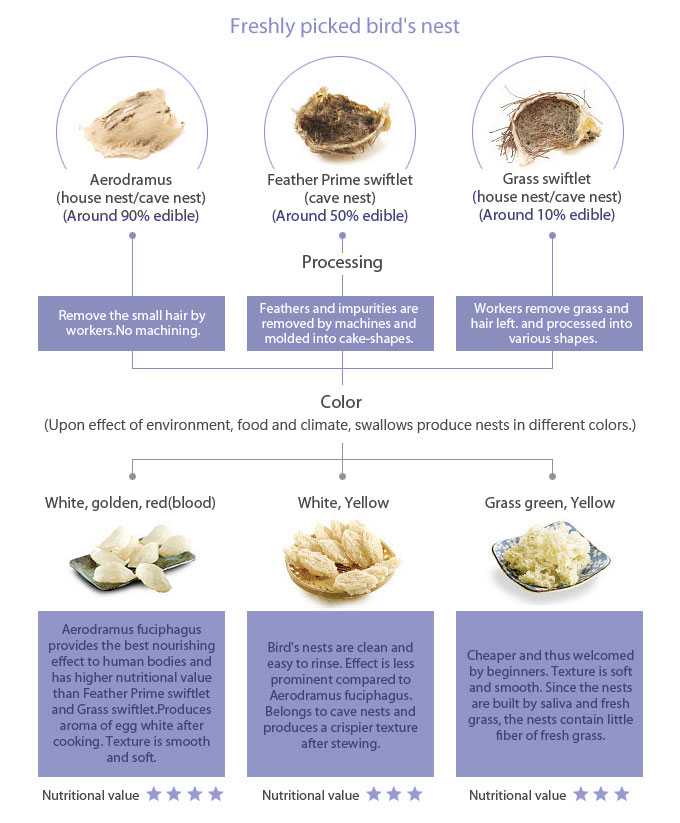
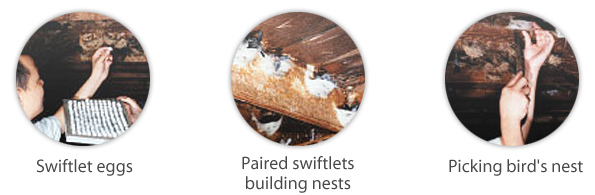
Swallow builds nest inside a house called swiftlet. House roof is made of wood. The internal setting of the house imitates the temperature, luminosity and humidity of natural caves. Average temperature is 28°C to 30°C and humidity lies between 89% and 90%, environment is humid and dark. Swallows leave the swiftler house in the morning to look for food outside until evening. Since environment is ideal, there is little impurities and feathers in the bird´s nest and it is cleaner with more complete shape like a boat or a spoon. According to swiftlets´ color they can be divided into white, yellow and red (blood). White nests are softer and smoother while golden nests and red (blood) nests are crispier in texture.
New Knowledge of the Red (Blood) & Yellow Bird´s Nests before purchase
Up to now, there are many controversies over the formation of the Red (Blood) Bird´s Nest. It is believed that the formation of the Red (Blood) Bird´s Nest is because the swallows have consumed several kinds of food. There are different arguments in academia whether this is due to the enzyme of the food, bacteria of the food, chemical reaction or heat in the food. It is also believed that if the swallows´ feces are collected from the swiftlet house and placed next to the bird´s nest for a week (during that the bird´s nest will be stored in plastic container and separated from the swallows´ feces by the gauze) can also formulate the Red´s nest. We have consulted many industry practitioners and believed that over 90% of Red (Blood) Bird´s Nest sold in the market (including us) are formatted based on the latter rationale.
The process of the color formulation of Red (Blood) Bird´s Nest: Bird´s nest will turn white color into yellow color. Then, yellow bird´s nests turn into orange and finally into red (blood bird´s nest). The content of nitrite in yellow bird´s nests will be higher than white bird´s nests, but lower than red (blood) bird´s nests.
After random sampling for the content of nitrite in our red (blood) bird´s nests, the results are shown below:
| HK JEBN red (blood) bird´s nest | ||
| Dried bird´s nest 2600 ppm |
Rinsed and soaked bird´s nest 88.1 ppm |
Stewed bird´s nest 33.6 ppm |
It shows that after rinsing, soaking and stewing processes, the content of nitrite in bird´s nest drops significantly.
Above result is the average amount based on the testing of the mixture of our few selected piece of red (blood) bird's nest products which are blended together. The content of the nitrite in red (blood) bird's nest of each piece will be varied from 1000ppm to 10000ppm etc.
Acceptable daily intake (ADI) of nitrite is 0.07mg per 1kg body weight. For instance, a 60kg adult will exceed his ADI of nitrite only if one consumes 125g dried red (blood) bird's nests a day. In other words, it means that only if consuming at least 16 pieces of red (blood) bird's nests a day will an adult exceed the standard, assuming the weight of 1 piece equal to 0.2 tael (7.56g).
Since the content of nitrite in bird´s nests is not listed in Hong Kong regulations, we list out the content of nitrite in meat products here for reference.
| Pork and poultry products | |
| Non-heat treated 200 ppm |
Heat-treated < 125 ppm (within acceptable range) |
Remarks:
1. Source: Preservatives in Food Regulation (Cap. 132BD), Schedule 1
2. 1 ppm=1/1,000,000; Example:1 ppm means there is 1 mg of nitrite in 1 kg of bird's nests
(2) Cave Nest:
Swallows build their nests on mountain caves, rock caves and cliffs. Affected by natural climate and environment, the texture tends to be stiffer and harder, with a darker color and less appealing appearance. There are more impurities in cave nest and it takes longer time to soak, giving a crispier texture.
Varieties
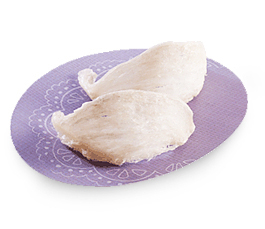
Bird´s nests sold on the market include natural bird´s nest cups, strips, threads, crumbles and scattered pieces processed into cakes of different shapes. There are three major types: